In the French Quarter, Short-Term Rentals Are Banned Almost Everywhere. One Corridor Is the Exception.
September 3, 2026
September 3, 2026
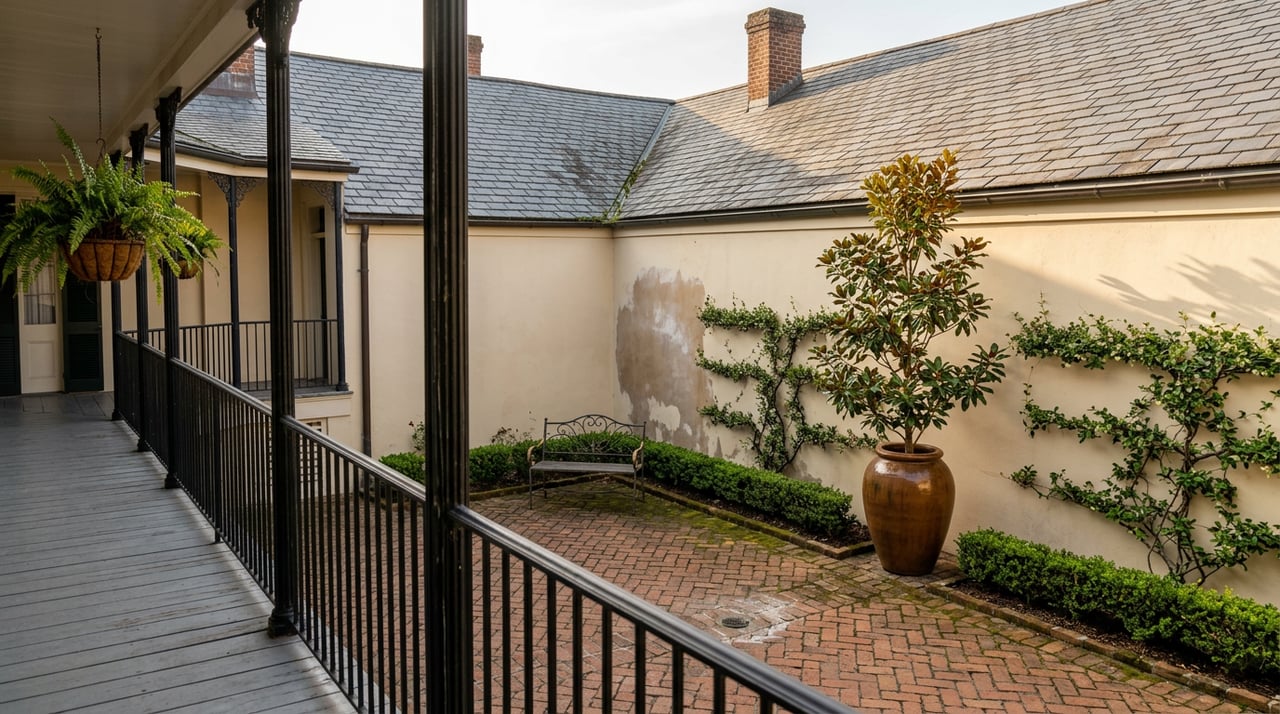
A buyer touring a Creole cottage on Dumaine Street sees exactly what draws visitors to this ten-block grid year after year: horse-drawn carriages, a balcony with sightlines to Jackson Square, a courtyard that photographs like a postcard. The math writes itself in their head before the showing ends. Nightly rate times occupancy times a location tourists already pay to visit. It feels like the safest short-term rental bet in the city.
It is also, for the overwhelming majority of Quarter addresses, not legal.
New Orleans' zoning code splits the Vieux Carré into three residential and mixed-use districts, VCR, VCC, and VCS, and none of them list short-term rental as a permitted use. The only carve-out sits in a narrow slice of the neighborhood called the VCE entertainment district, which tracks the Bourbon Street corridor. Everywhere else in the French Quarter, a non-commercial short-term rental permit simply is not available, no matter how clean the application or how strong the buyer's credit.
That single fact reshapes how a French Quarter purchase should be underwritten, and it is the piece most out-of-state buyers discover only after they have already made an offer.
It helps to separate two city bodies that get conflated constantly in French Quarter real estate conversations. The Vieux Carré Commission reviews what a building looks like from the street: paint, ironwork, windows, signage. It does not decide what a building is allowed to be used for. That question belongs to the city's Comprehensive Zoning Ordinance, administered separately from VCC review.
Under that ordinance, the Quarter's core residential and mixed-use zones do not include non-commercial short-term rental (NSTR) among permitted uses. A property can have a flawless VCC compliance history, updated wiring, and a homestead exemption in the owner's name, and still be unable to hold an STR permit simply because of where its lot sits on the zoning map. The distinction matters because a buyer can spend months clearing VCC hurdles for a renovation and still end up with a building that cannot legally host paying guests for stays under thirty days.
The zoning breakdown, in practical terms:
That last point is worth sitting with. Even in the parts of New Orleans where NSTR is allowed, the unhosted, hands-off Airbnb model that many buyers picture does not exist. In the Quarter, the question is moot before it gets that far, because the use itself isn't on the table outside VCE.
The VCE corridor is real, but it is not a loophole a buyer can lean on for a typical Quarter purchase. It covers a specific commercial stretch built around bars, hotels, and nightlife uses, not the residential courtyard cottages and Creole townhouses that make up most of the neighborhood's housing stock. A buyer drawn to the Quarter for its architecture and quiet courtyards is, almost by definition, not shopping in the blocks where the STR exception applies.
This is the gap between the tourism narrative and the zoning map. The Quarter's visitor traffic is real. The legal path to monetizing a residential property through nightly rentals is not, outside a commercial sliver most buyers never consider living in.
In October 2025, the Fifth Circuit Court of Appeals struck down New Orleans' prohibition on corporate ownership of short-term rental permits, ruling it unconstitutional. Investors reading the headline could be forgiven for assuming the door just opened for LLCs to build a Quarter STR portfolio.
It didn't, at least not in any way that helps a new buyer. The ruling applies to commercial STR (CSTR) permits, and the city is not issuing new CSTR permits. The practical effect is narrow: an LLC can now acquire a property that already holds a valid, existing CSTR license and take over that license through a transfer, rather than being blocked from corporate ownership outright. It does not create new licenses, and it does nothing for the NSTR category that governs residential use. For a buyer without an existing licensed property already in hand, the ruling is a footnote, not a strategy.
Before June 2025, an owner in a restricted zone might have gambled on listing anyway and hoping enforcement stayed thin. That gamble no longer works the way it used to. Since June 2025, Airbnb and Vrbo have been required to verify a city-issued permit before allowing a listing to accept bookings, which means an unlicensed Quarter property isn't just legally exposed, it is invisible to the platforms that would generate the income in the first place. The city has also leaned into direct enforcement, with fines that can run from $500 to $1,000 per day for operating without a permit. There is no quiet workaround left to underwrite around.
Even a buyer who has no interest in short-term rental income and simply wants to update a kitchen or repair a balcony runs into a second layer of friction unique to this neighborhood. Any exterior change visible from the street, and in the Quarter that includes work not visible from the street too, goes through Vieux Carré Commission review before the city will issue a building permit. Staff can approve simple in-kind repairs administratively within days to a few weeks. Anything that reaches a full commission hearing typically takes four to twelve weeks for straightforward cases, and complex or contested projects can run months longer.
Recent VCC agendas show what that caseload actually looks like on the ground: a stop-work order issued after a historic balcony railing was removed without approval, a foundation repair application working through review after being filed earlier in the year, and a courtyard window enclosure still pending after being submitted years earlier. These aren't hypothetical delays. They are the neighborhood's normal pace of doing business, and a renovation budget or resale timeline built on a national contractor's turnaround estimate will run into it.
Before writing an offer on a property with renovation plans, it is worth pulling the building's VCC history. The VCC Foundation maintains the Vieux Carré Virtual Library, a free, map-based archive of historic photographs, GIS records, and building color ratings for properties across the district, which can surface prior approvals, conditions, or violations tied to a specific address before a buyer commits to a timeline.
None of this means a French Quarter purchase is a poor decision. It means the return has to come from somewhere other than a nightly rental calendar. Long-term leasing, personal second-home use, and owner-occupied living all remain straightforward and are, in practice, how most Quarter residential real estate performs. The neighborhood's price signals reflect a market working through exactly this kind of nuance rather than a single clean trend line. Over the three months ending May 2026, French Quarter homes sold at a median of $421,000, up 6.6 percent from the same period a year earlier, while the average sale price for the single month of May 2026 came in lower and had fallen year over year, a reminder that small sample sizes in a ten-block neighborhood make headline percentages easy to misread without asking what specifically sold.
This is where local guidance earns its keep. Leslie Perrin's background in historic preservation and her Historic Home Specialist designation are directly relevant here, not as a credential to display but as the actual skill set needed to read a property's VCC file, gauge realistic renovation timing, and confirm zoning before a client falls in love with a courtyard that can't do what they hoped it would.
Can I still rent a French Quarter property long-term? Yes. Leases of thirty days or more fall outside short-term rental regulation entirely and remain a standard, straightforward option across the neighborhood.
Does the corporate ownership ruling let me start a new short-term rental business in the Quarter? No. It only affects transfers of existing, already-issued commercial permits, and the city is not issuing new ones.
If I live part of the year in the Quarter, can I rent it out the rest of the time? Only within the VCE corridor along Bourbon Street would a short-term rental permit even be available. Outside that zone, a property functions as a full-time residence or a long-term rental, not a hybrid.
If you're weighing a French Quarter purchase and want the zoning map read correctly before you fall for the courtyard, the Francher Perrin Group can walk the property's VCC file and zoning status with you before you write an offer. Start with our buyer's guide or request a free home valuation if you're weighing a sale on the other side of this same neighborhood.
Stay up to date on the latest real estate trends.

From first showings to closing day, we’re committed to delivering a seamless, elevated real estate experience tailored to your goals. Whether you’re buying, selling, relocating, or investing, the Francher Perrin Group is here to guide you with trusted expertise, personalized service, and a deep understanding of New Orleans real estate.
FRANCHER PERRIN GROUP
7934 Maple Street New Orleans, LA 70118 2734 Prytania Street New Orleans, LA 70130